Working with PBSG
Contractor Models Explained
We understand that many practitioners haven’t had much experience with the sub-contracting model, so we’ve put together this guide to give you a clear and practical overview of how each model works, what supports you’ll receive, and what you can expect in terms of earnings, supervision, and caseloads.
Our aim is to to empower you with the information you need to decide if this pathway feels right for you before moving forward to explore the opportunity of working with us and organising an interview.
Our Two Models
We offer two subcontracting models, meaning you can choose the pathway that best fits your lifestyle, preferences, and financial goals.
ABN Model – $123.20/hour
- $110/hour paid directly to you
- $13.20/hour (12%) contributed to your superannuation fund
- Total: $123.20/hour
- Travel is paid at half rate: $55/hour
ACN Model – $124/hour
- $124/hour paid directly to you
- You are responsible for managing your own superannuation (you can choose whether to contribute to super or not)
- Travel is paid at half rate: $62/hour
Note: Registering an ACN through ASIC currently costs around $576 upfront, with an ongoing annual fee of $310. Registering an ABN is free.
Once registered for GST, we pay an additional 10% to offset the cost (ACN $136.4/hr & ABN $121/hr)
Supervision
(applies to both models)
We believe supervision is most effective when practitioners can choose a supervisor who aligns with their clinical style, values, and areas of interest. For this reason, all supervision is externally sourced.
Most external supervisors charge between $150–$200 per hour. To help you select the right fit, we’ll provide a list of highly recommended supervisors, including pricing, descriptions of their clinical experience and style of supervision. You are also welcome to choose a supervisor from outside of our recommendations.
To support our practitioners with cost of external supervision, we contribute a higher pay rate for clinical supervision time billed to a participant. For up to a total of 2 hours per month, we pay billed supervision at $200/hour for practitioners engaged under an ACN and $178/hour (plus $21.42/hour contributed to superannuation) for practitioners engaged under an ABN. This ensures you can access high-quality clinical guidance without financial barriers.
When discussing specific participants, you may bill that time to the participant’s NDIS plan in line with NDIS guidelines. Any supervision beyond the 2-hour monthly contribution is can still be billed to a participant but is paid at a base rate.
Please note:
Only participant-related discussion can be billed to a participant’s plan
General professional development or PBS-related discussion is not billable
Sample supervision session
John Smith – 12 minutes (billable)
Jane Brown – 15 minutes (billable)
Andrew Love – 18 minutes (billable)
General PBS discussion (e.g., practitioner evidence portfolio) – 15 minutes (not billable)
In this example, you would bill 45 minutes split between the three participants, and you would cover your supervisor’s fee yourself. PBSG would pay for the 45 minutes at a higher rate of $200/hr.
Financial Comparison
Example Company Employee vs PBSG Subcontractor
Note: the table is easier to compare when viewing on a computer rather than a phone.
| Category | Employee | PBSG ACN Model | PBSG ABN Model |
|---|---|---|---|
| Base Hourly Rate | $48/hr | $124/hr | $110/hr + $13.20/hr super = $123.20/hr |
| Superannuation | Employer contributes 12% ($5.76/hr) | You choose if/what to contribute | 12% ($13.20/hr) contributed |
| Tax | PAYG withheld by employer | You manage tax (deductions possible) | You manage tax (deductions possible) |
| Leave (annual/sick) |
Paid (≈20 days annual + 10 sick days) | No paid leave (rate compensates) | No paid leave (rate compensates) |
| Travel Adjustment (approx. 15% of weekly hours at half rate) |
N/A (all hours same rate) | Avg effective: $110.83/hr | Avg effective: $110.30/hr |
| Non-Billable Time | ~25% still paid (meetings, admin) | Only paid for billable + travel hours | Only paid for billable + travel hours |
|
Hourly Equivalent (accounting for approx. 25% non-billable hours allowed as employee) |
$48 × 1.25 = $60/hr |
$110.83/hr | $110.30/hr |
|
Weekly Earning (based on 38 hours) |
$60 × 38 = $2,280/week |
$110.83 × 38 = $4,211.54/week |
$110.30 × 38 = $4,191.40/week |
|
Yearly Earning (52 weeks) |
$2,280 × 52 = $118,560 |
$4,211.54 × 52 = $218,200.08 |
$4,191.40 × 52 = $217,552.80 |
|
Yearly Earning (with leave factored) |
$118,560 (includes 6 weeks paid leave) |
$4,211.54 × 46 = $193,331 (if you subtract 6 weeks for leave) |
$4,191.40 × 46 = $192,804 (if you subtract 6 weeks for leave) |
Referrals - Building A Caseload
From the moment you join PBSG, we’re committed to helping you build a caseload that feels right for you. We actively provide referrals as early as possible, while being intentional about ensuring the participants you support are a good fit.
Referrals don’t always arrive in a neat, predictable stream. That’s simply the reality of this space, and we believe in being upfront about it. At times, you may receive several referrals in a short period, while at other times things may move more gradually.
It’s also important to understand that behaviour support is often a front-loaded service. New participants can involve 20+ hours upfront across assessment, plan development, training, and early intervention before transitioning into more consistent ongoing supports. This can help build momentum in billable hours during the early stages.
On average, it may take around 12–24 weeks to establish a full caseload. This period can feel like the most challenging part of the transition. However, once practitioners experience the increased income, flexibility, and autonomy, the feedback is consistently the same: “I’d never go back.”
We want to be transparent that the first couple of months can feel uncertain and challenging if subcontracting is new to you. Many practitioners choose to transition gradually or maintain some existing work initially to create stability while their caseload builds. As your caseload grows and your income becomes more consistent, the model begins to feel increasingly stable and predictable over time.
It’s important to reflect on whether you’re someone who feels comfortable navigating a period of initial uncertainty, and whether other areas of your life are currently stable and supportive enough to take on that transition. For those who value flexibility, autonomy, and higher earning potential, we hear from our practitioners that it is a move which has greatly paid off for them.
In building a caseload, we also want you to build a caseload that genuinely fits you. If a participant isn’t the right match, that’s completely okay. We will work with you to facilitate a handover where needed. We stay in close communication around your capacity and preferences so you are never over- or under-loaded.
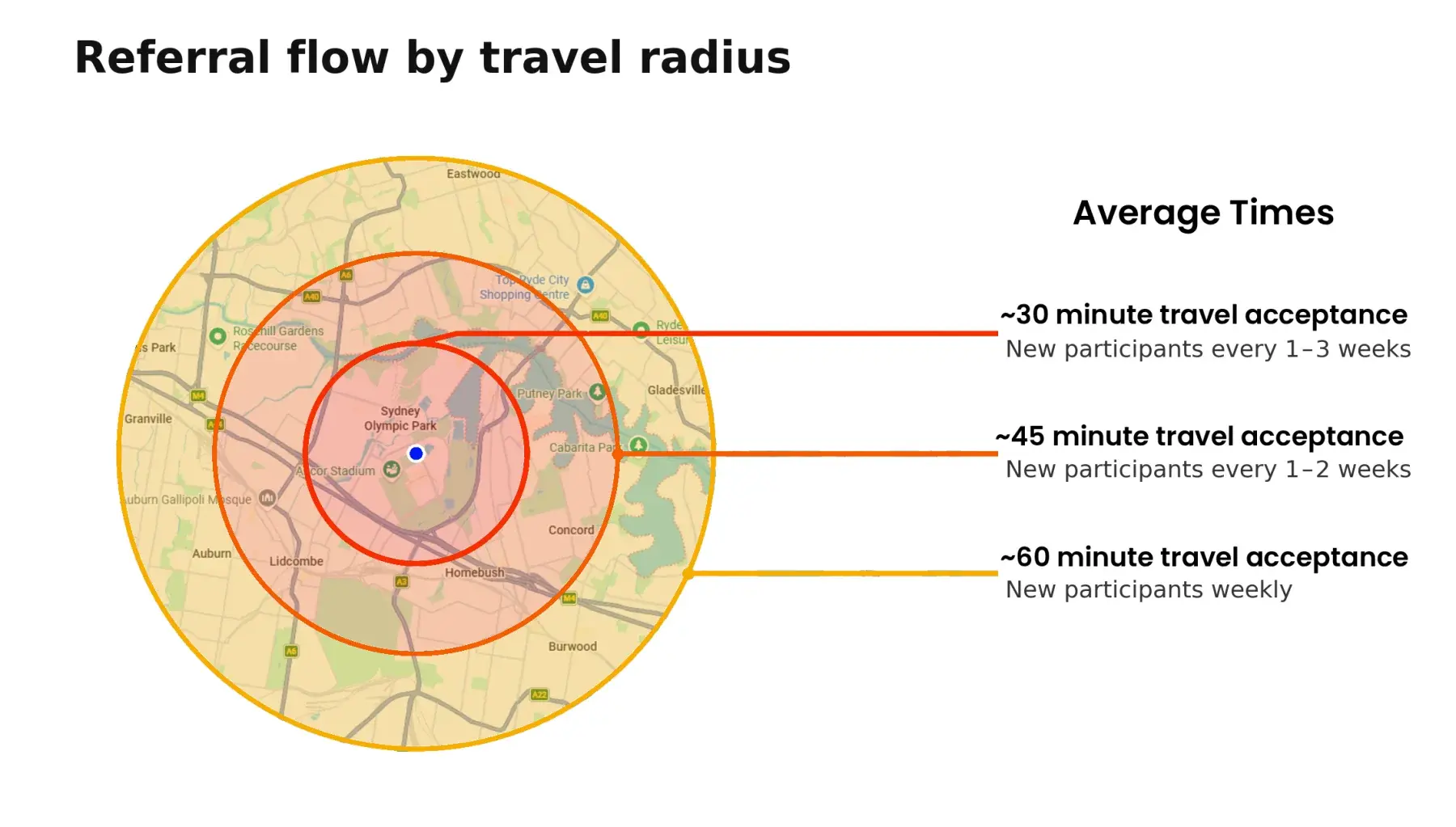
As a general guide, referral flow can vary depending on your preferred travel radius. Based on our historical data and current intake rates, we typically see the following patterns, although it can vary:
| Travel Radius Accepted | Typical New Participant Availability |
|---|---|
| 30 minutes | Every 2–3 weeks |
| 45 minutes | Every 1– 2 weeks |
| 60 minutes | Weekly |
We also have active waitlists in a some areas, meaning a number of participants are ready and waiting for immediate service.
Other FAQs
-
Under Australian law, you’ll need to register for GST (Goods and Services Tax) if your business turnover is more than $75,000 per year. This threshold applies whether you’re operating under an ABN or an ACN.
At PBSG, we want to make sure GST is never a financial burden. Once you are registered, we pay you an additional 10% on top of your hourly rate to cover the GST cost. You then remit this directly to the ATO in your Business Activity Statement (BAS).
-
Yes, there are a few overheads you’ll need to factor in as a contractor. The good news is that these costs are very low compared to your increased earnings, and most are tax-deductible.
Additional expenses include:
Professional indemnity and public liability insurance – around $300 per year (tax deductible). This is essential for protecting yourself as a practitioner.
Accounting fees – if you choose to use an accountant (which we recommend), there will be a cost. A good accountant will more than pay for themselves by maximising deductions and helping you plan tax effectively.
In practice, most contractors find that these overheads are minimal compared to the significant jump in hourly rate, and with the right accountant, much of it can be claimed back at tax time.
-
We pay practitioners on a monthly basis. Each month, we generate an invoice for you automatically. Once you review and confirm it, you are paid for all your billed work for the previous month.
You Got This!
Transitioning into subcontracting can feel like a leap, but it’s one that so many practitioners tell us has transformed their careers and lives. Higher pay, more freedom, and the ability to shape your own caseload all add up to a working life where you feel valued, respected, and in control.
At PBSG, we’re here to walk alongside you every step of the way – from your very first referral, to building a caseload that excites you, to ongoing professional supervision and support. We want you to thrive not just as a practitioner, but as a person.
If you’re ready to explore the model that suits you best, we’d love to talk.
Please note
The information provided in this guide is for general educational purposes only and should not be taken as legal, financial, or tax advice. Individual circumstances vary, and laws and regulations may change. If you are unsure about your obligations or what is best for your situation, we recommend seeking independent advice from a qualified lawyer, accountant, or financial advisor.